
How to calculate the motor drive torque of ball screw
May 18, 2023 · 3 min read

① Fast running, non-* calculation can be applied to the following formula: Ta= (Fa*I)/(2*3.14*n1)
In formula
Ta: driving torque kgf.mm;
Fa: axial load N (Fa=F+μmg, F: axial cutting force of the lead screw N, μ : comprehensive friction coefficient of the guide, m: weight of the moving object (workbench + workpiece)kg, g:9.8);
I: lead of lead screw mm;
n1: Positive efficiency of feed screw.
② Assumed working conditions: horizontal use, servo motor directly driven, 2005 ball screw drive, 25 ball linear guide bearing and guiding, ideal installation, vertical uniform load 1000kg, motor power:
Fa=F+μmg, set cutting force aside, set the comprehensive friction coefficient μ=0.1, Fa=0.1*1000*9.8=980N;
Ta= (Fa*I)/(2*3.14*n1), n1=0.94, Ta=980*5/5.9032≈830N.mm=0.83N.M
According to this number, you can choose the motor power. Taking a brand of servo made in Taiwan as an example, it is known from the sample that the servo motor with rated torque greater than 0.83N.M is 400W. (200W is 0.64N.M, which is small. 400W rated at 1.27N.M, 1.5 times the required theoretical torque, meets the requirements)
Of course, the end mounting part and the ball screw nut preloading and poor lubrication will produce static torque, also known as initial torque, on the system, the actual choice is to consider. In addition, the friction coefficient of guide parts can not be calculated by single theoretical value, such as the ball guide rail, the total friction coefficient after multiple sets of assembly must be greater than the sample parameter. Furthermore, the results only consider the load driving the rest, and in the case of equipment such as machine tables, the effect of the cutting forces in each direction is also considered.
If the acceleration is considered, more detailed calculation can refer to the following formula (personal sorting and correction, hope friends in the industry guidance) :
Horizontal use of ball screw driving torque and motor power calculation:
Actual driving torque: T=(T1+T2)*e
T: actual driving torque;
T1: torque at constant speed;
T2: torque during acceleration;
e: Margin factor.
Driving torque at constant speed: T1= (Fa*I)/(2*3.14*n1)
T1: constant speed driving torque kgf.mm;
Fa: axial load N [Fa=F+μmg, F: screw axial cutting force N, μ: guide piece comprehensive friction coefficient, m: moving object weight (workbench + workpiece)kg, g:9.8];
I: lead of lead screw mm;
n1: Positive efficiency of feed screw.
Driving torque at acceleration: T2=T1+J*W
T2: driving torque kgf.m during acceleration;
T1: driving torque kgf.m at constant speed;
J: toward a motor inertia torque kg. M squared [J = Jg1 Jm + + (N1 / N2) squared * (Jg2 + Js + m * 3.14 (1/2) squared).
W: angular acceleration rad/s² of the motor;
Jm: inertia torque of the motor kg.m²;
Jg1: Inertia torque of gear 1 kg.m²;
Jg2: Inertia torque of gear 2 kg.m²;
Js: Inertia torque of lead screw kg.m²
(Jg1 and Jg2 can be ignored for direct motor drive)
If the ordinary induction motor is used, the power is calculated according to the following formula:
P=TN/9549
P: power; T: torque; N: rotational speed
③ Note: servo motor and stepping motor are very different. The starting torque of stepping motor is relatively large, otherwise, there will be a phenomenon of losing step.
Related products
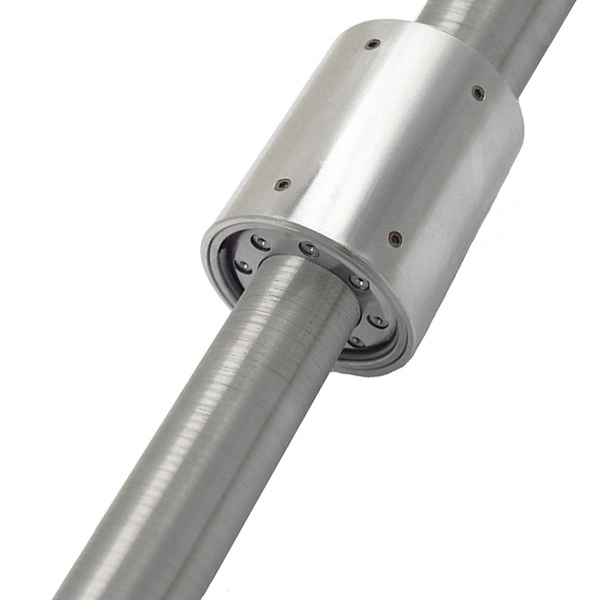
STR SERIES
STR SERIES is part of the Series Motion planetary roller screw portfolio.
View product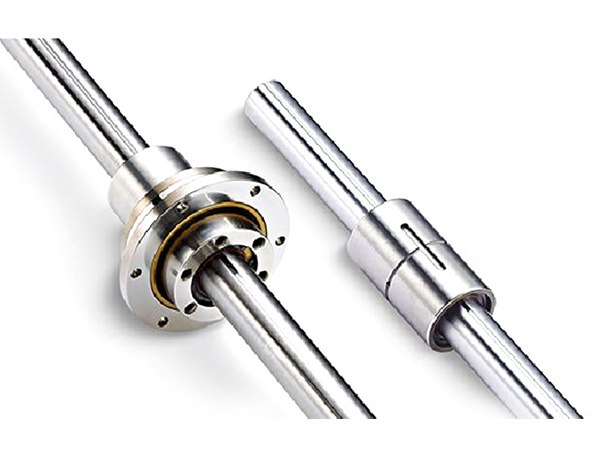
SL SERIES
Ball Spline is a precision mechanical transmission element suitable for applications requiring high precision, high rigidity, high speed and large loads, especially for round-trip and rotary movements.
View productSO SERIES
Ball Spline is a precision mechanical transmission element suitable for applications requiring high precision, high rigidity, high speed and large loads, especially for round-trip and rotary movements.
View product