

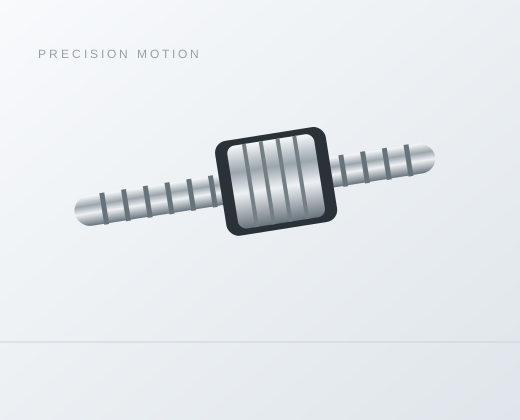
PCG5010 Rolled Ball Screw
Series / Model PCG5010
Review PCG5010 rolled ball screw dimensions: 49.31 mm shaft, 10 mm lead and 103 mm nut length. Compare mounting details and request engineering confirmation.
Overview
PCG5010 is a PCG reference in the catalog’s Stock Rolled Ball Screw section. Its row lists d = 49.31 mm, a 10 mm lead and L = 103 mm. Use this page to review the model’s geometry and prepare a configuration inquiry.
Review the M72x2 interface
PCG5010 uses A = M72x2, D = 78 mm and L = 103 mm. Those values differ from the M70x2 interface of PCG5005 and the M80x2 interface of PCG5020. Keep d = 49.31 mm at its printed precision when requesting a shaft drawing and confirming the proposed assembly.
PCG5010 catalog dimensions and ratings
| Parameter | Reference | Unit |
|---|---|---|
| Shaft d | 49.31 | mm |
| Lead I | 10 | mm/rev |
| Ball diameter Da | 7.144 | mm |
| Circuits n | 4 | count |
| Basic dynamic rating Ca | 53250 | N |
| Basic static rating Coa | 113890 | N |
| Nut body D | 78 | mm |
| Nut length L | 103 | mm |
| B | 30 | mm |
| Mounting thread A | M72x2 | metric thread |
Dimensions retain the source symbols and printed precision. I denotes lead, Da ball diameter and n the source number of circuits. Ca and Coa are basic dynamic and static ratings in newtons. Do not treat either rating as an allowable payload or a complete life calculation.
Compare PCG5010 with PCG5005
| Field | PCG5010 | PCG5005 |
|---|---|---|
| d | 49.31 | 49 |
| I | 10 | 5 |
| D | 78 | 75 |
| L | 103 | 65 |
| A | M72x2 | M70x2 |
The comparison uses separately verified catalog rows. Matching dimensions support an initial envelope review only. Different leads change travel per screw revolution, while the required rotational speed still depends on the target linear speed. Neither the table nor the model name establishes accuracy grade, preload or supplied configuration.
Installation and inquiry checklist
For this PCG nut, A = M72x2 is the mounting-thread designation, not a flange diameter. Review it together with B = 30 mm, D = 78 mm and L = 103 mm. Confirm mating-thread tolerance, engagement, shoulder seating and locking method on the assembly drawing.
- Identify PCG5010, rolled process, quantity, working stroke and overall screw length. Attach the screw-end and nut-housing drawings.
- Provide axial force through the complete cycle, travel speed, acceleration, mounting orientation and required life. Review buckling and critical speed for the actual unsupported span.
- State positioning requirements, acceptable axial play, lubrication access and environmental protection. Confirm offered preload, accuracy and inspection conditions with engineering.
Allow for support bearings, end clearances and maintenance access beyond the listed nut length. Confirm the offered assembly and drawing revision before committing the machine layout.
Questions about PCG5010
Does PCG5010 specify the complete screw length?
No. The catalog lists L = 103 mm for the nut. Working stroke, screw length, end machining and support locations must be specified separately.
Can PCG5010 replace PCG5005 without a drawing check?
No. The comparison preserves each row’s d, lead, D, L and A values. Confirm the full mounting interface, shaft ends, load cycle and motion requirements; the catalog does not establish interchangeability.
What does the PCG5010 load table establish?
The source lists Ca = 53250 N and Coa = 113890 N as basic ratings. They are not permissible machine loads. Confirm the rating basis, duty cycle, life target and safety checks before selection.
Source and engineering confirmation
See the original ball screw catalog, PDF page 6 (printed page 5); the PCG header and drawing are on PDF page 5. These are catalog reference values. Engineering must confirm the exact offered dimensions, configuration and controlled drawing. The historical section title does not establish current stock, price or delivery.
Send the model and duty details through the PCG5010 configuration inquiry.
Need help selecting a model or configuration?
Catalog reference only. Confirm the offered assembly, controlled drawing, duty cycle and commercial terms.