
Custom Screw Assembly RFQ: Define the Operating Conditions and Supply Scope
October 21, 2026 · 3 min read
Series Motion · Engineering and procurement guide
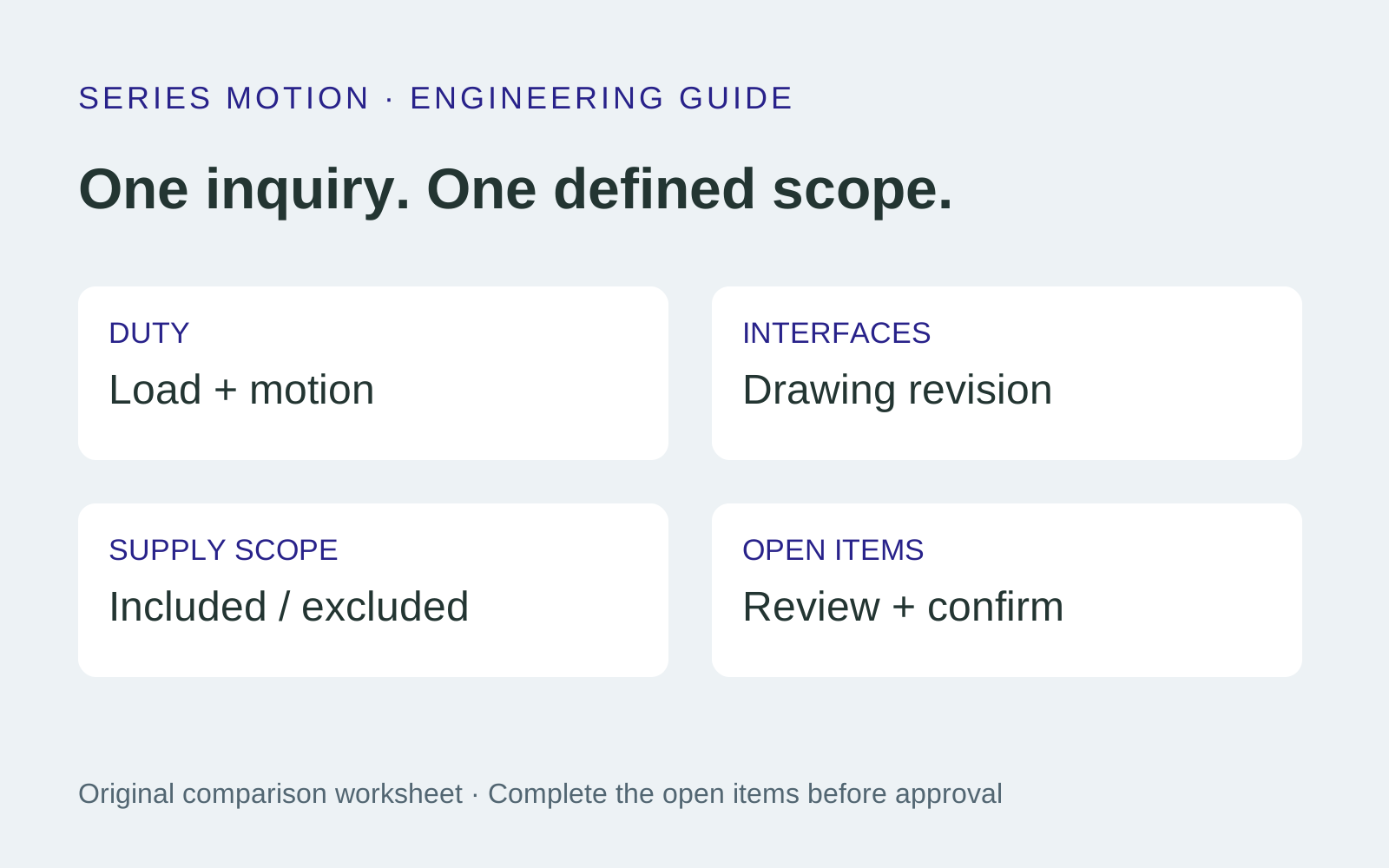
To obtain comparable quotations for a custom screw assembly, tell each supplier how the machine will operate and which components you want them to supply. If one quote covers a screw and nut while another includes supports, end machining and a motor interface, the price difference does not yet describe a like-for-like choice.
Give each supplier the same requirements sheet and use it to compare the proposed product alternatives. Mark each item as mandatory, preferred or still to be confirmed. This helps separate a configuration that needs engineering review from one that meets an agreed requirement.
1. Define the operating conditions before selecting a model
State the usable travel, installation orientation and mass to be moved. Then specify the force required by the process and the direction in which it acts. Describe the sequence and timing of each move, acceleration period, dwell and return. Also state the number of cycles per hour and the expected operating hours. Specify the period covered by those operating hours. Give peak events separately from normal operation. A single “maximum load” number can hide the difference between a short process-force peak and a sustained holding demand.
For an actuator inquiry, include the force–stroke–time worksheet. For a screw assembly, also identify the guide arrangement and support locations. These inputs support a selection review; they do not establish a permissible load from a catalog rating alone.
2. Make the supply scope comparable
| Item | Your requirement | What the quote should identify |
|---|---|---|
| Screw and nut | Family if known; usable travel; lead; handedness; nut orientation | Exact proposed reference and drawing revision |
| Interfaces | Existing supports, coupling and housing to retain; available envelope | Included end machining and any unresolved mating dimensions |
| Supports and accessories | Required items, or explicitly “not requested” | Which supports, retention parts and accessories are included or excluded |
| Motor and controls | Existing hardware and interface constraints; scope still to be decided | Mechanical interface only, or separately identified electrical items |
| Verification | Positioning and repeatability requirements with test conditions | Agreed inspection deliverables and exclusions |
| Commercial basis | Quantity, delivery destination and required date for discussion | Quoted quantity, delivery terms and confirmed timing rather than assumptions |
The sheet is a comparison aid, not a list of components included with every Series Motion product. If you do not need an accessory, say so. If its selection is unresolved, request a proposal instead of assuming that a matching model number establishes compatibility.
3. Attach drawings without inventing missing values
Provide an assembly sketch plus the relevant shaft-end and nut-mounting drawings. Identify drawing number, revision, units and review status. Separate dimensions measured from an old part from requirements for the new part. Photographs help explain the arrangement; they do not establish an unmarked bore, bearing fit or manufacturing tolerance.
State the dimension or feature that may change, and why. Catalog models are starting points for discussion. Custom diameter, lead and interface requirements can be submitted for review; feasibility and the final drawing must be confirmed. A listed example is not the complete supply range.
4. Close open items before approving the order
Compare each offer against the same sheet. Ask whether a difference is an exclusion, a proposed alternative or an unconfirmed item. Confirm the scope and drawing revision together. Do not treat a preliminary price, a web rendering or an unspecified accuracy grade as approval of the complete machine axis.
Start with the ball screw, lead screw or planetary roller screw information, then send your duty sheet and scope questions. Include the unresolved items so the discussion can address them directly.
Technical references
- Tolomatic — specifying electric rod actuators, Part 1 — Load, duty, force and velocity as application inputs.
- Tolomatic — specifying electric rod actuators, Part 2 — System envelope, thrust and environmental checks.
Guide prepared from the technical references above and the linked Series Motion product information. Examples are illustrative; final dimensions, configuration and acceptance requirements must be agreed for the application.
Related products
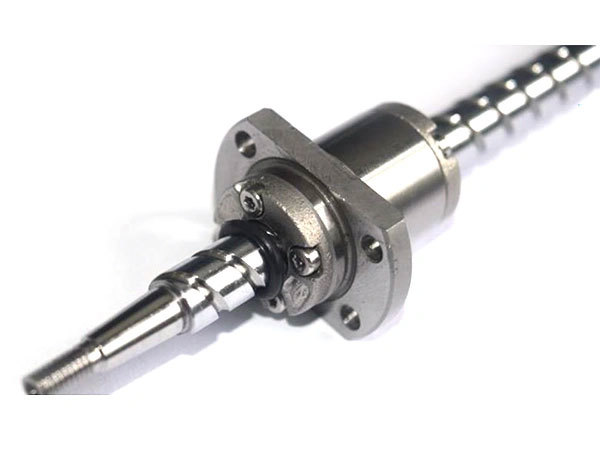
Ground Miniature Ball Screw
Ground miniature ball screws use ground raceways. Review the published model tables for diameter, lead, nut geometry and load ratings, then confirm accuracy and preload for the complete assembly.
View product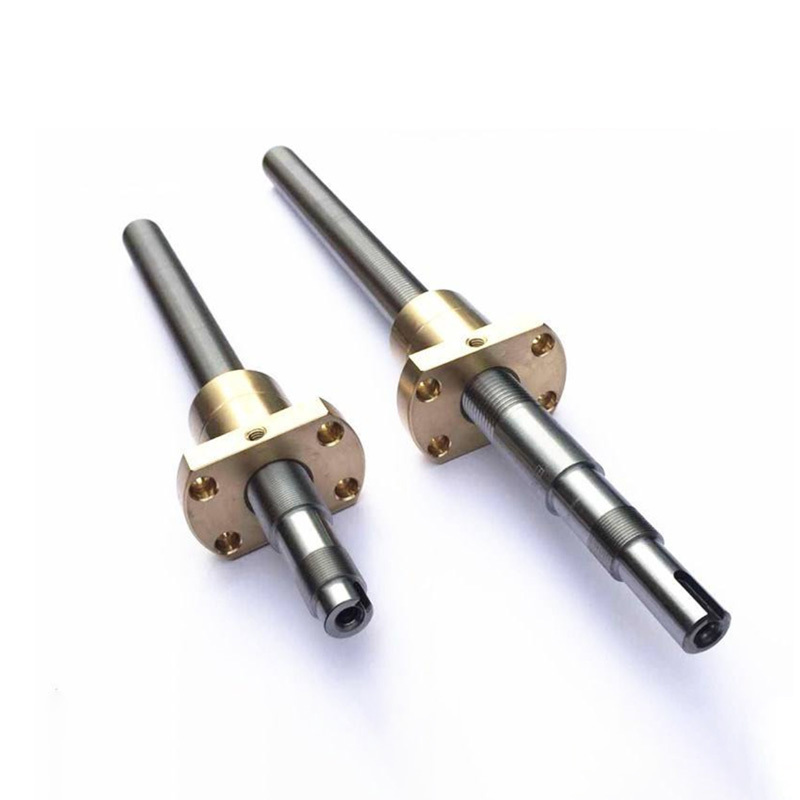
Trapezoidal Lead Screw
A trapezoidal lead screw converts relative screw-and-nut rotation into axial travel through sliding thread contact. Check diameter, lead, nut material, lubrication and duty cycle for the application.
View product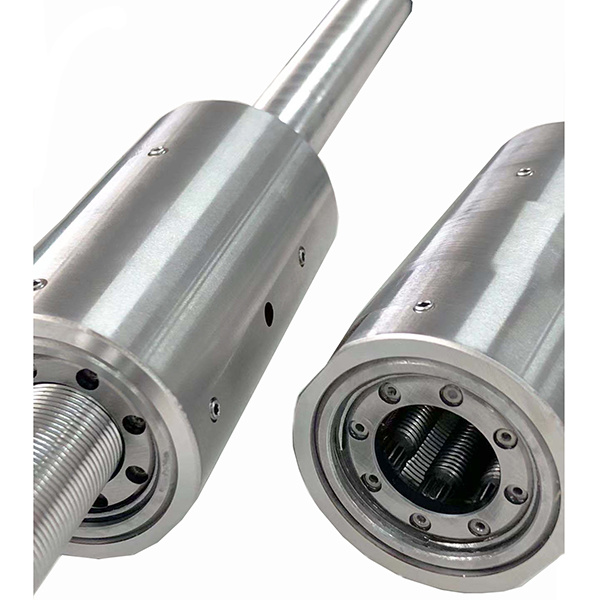
SRV Standard Planetary Roller Screw
The SRV standard planetary roller screw transmits axial motion through threaded rollers between the screw and nut. Use the SRV model tables to check diameter, lead, load ratings and mounting dimensions.
View product